
|
| Email Home Page |
|

|
|
|
| Email Home Page |
|
|
|
Series Connection:
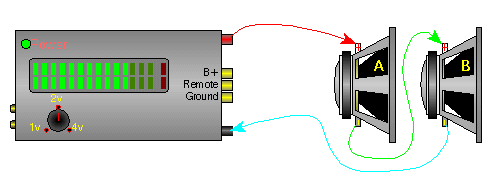
Parallel Connection:
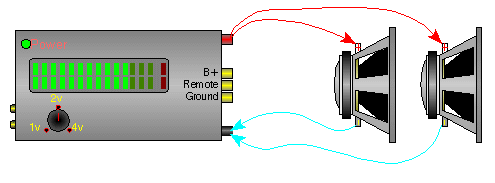
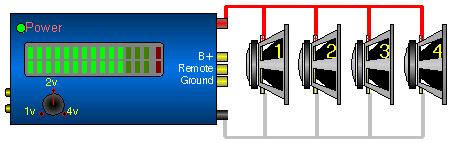
This is a series/parallel connection (below). Connecting individual woofers in a series configuration is not common in car audio. This is a lot more common in musical instrument (guitar and bass guitar) speaker cabinets.
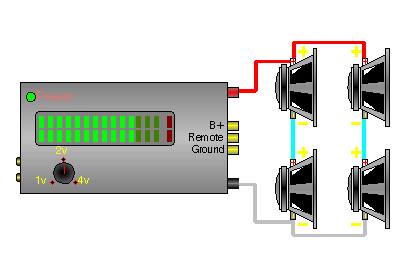
In the diagrams below, you can see the relative current flow from the amplifier's outputs (indicated by the red arrows) into various loads. At the bottom, you can see that 2 ohm mono (two 4 ohm speakers bridged) is the same as 1 ohm stereo (four 4 ohm speakers per channel).
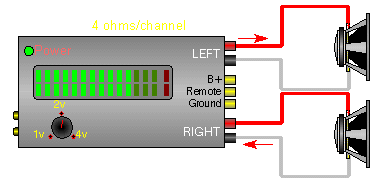
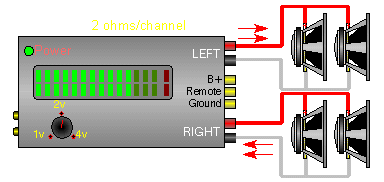
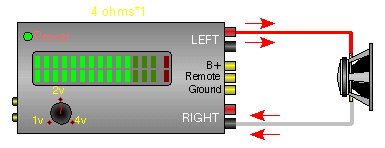
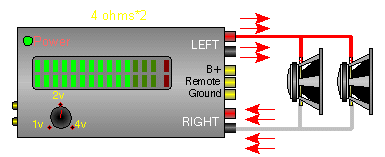
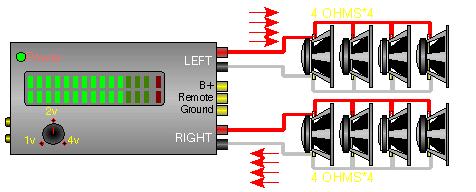
The image below shows the DVC speaker wired to both channels of a stereo amplifier. Each channel of the amplifier drives a 4 ohm load.
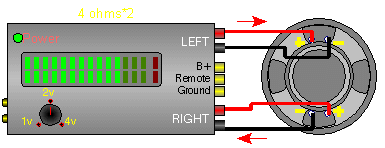
This image shows the DVC driver with both voice coils wired in parallel. This presents a 2 ohm mono load to the amplifier which may damage most amplifiers.
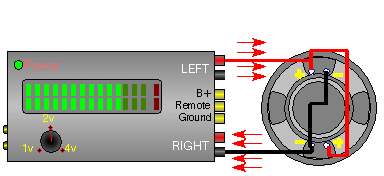
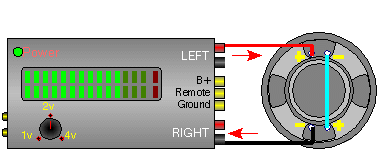
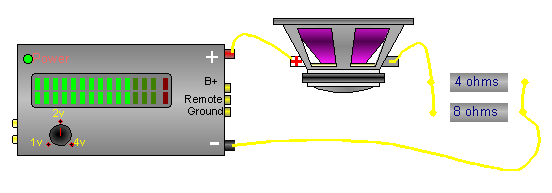
This image shows the two 4 ohm voice coils wired in series. This will present a 8 ohm mono load to the amplifier.
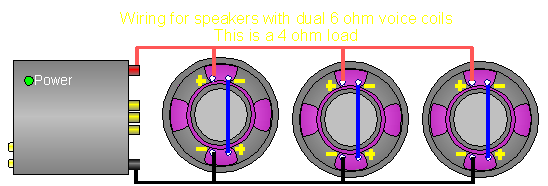
This diagram shows 3 DVC woofers with dual 6 ohm voice coils. The coils of each speaker are wired in series (which makes each speaker a 12 ohm speaker) and then all of the drivers are wired in parallel for a total of a 4 ohm load.
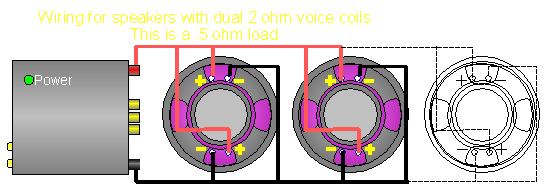
This diagram shows 2 DVC woofers with dual 2 ohm voice coils. The coils of each speaker are wired in parallel (which makes each speaker a 1 ohm speaker) and then all of the drivers are wired in parallel for a total of a .5 ohm load. You can calculate for more speakers by changing the input.
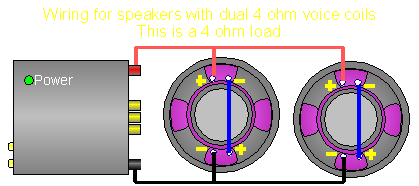
This is the wiring diagram for woofers with dual 4 ohm voice coils. This will give you a 4 ohm load. The voice coils of each individual speakers are wired in series. This gives each speaker an 8 ohm impedance. Wiring them in parallel will present the amp with a 4 ohm load.
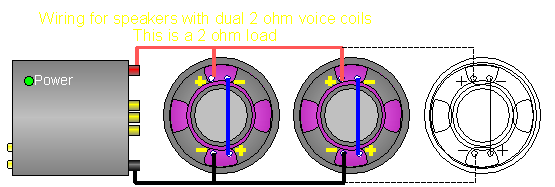
This is the wiring diagram for woofers with dual 2 ohm voice coils. This will give you a 2 ohm load. The voice coils of each individual speakers are wired in series. This gives each speaker an 4 ohm impedance. Wiring them in parallel will present the amp with a 2 ohm load. You can calculate for more speakers by entering the number of speakers in the correct field.
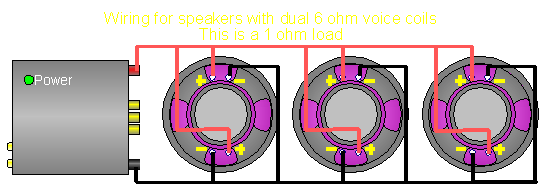
This diagram is a wiring diagram for 3 DVC drivers with dual 6 ohm coils. All of the voice coils are wired in parallel for a 1 ohm load. Class D and high current class AB amplifiers are probably the only amplifiers that can handle this load. Make sure that your amplifier can handle this load if you use this wiring configuration.
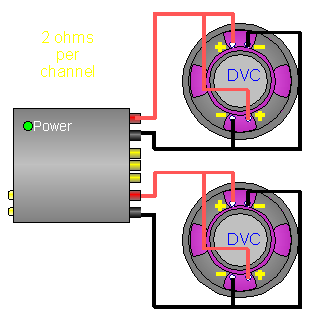
This diagram shows 2 DVC speakers with the voice coils wired in parallel. Each voice coil has an impedance of 4 ohms which results in a 2 ohm impedance for each speaker. One speaker is connected to each channel of the amplifier. This is a 2 ohm stereo load.
----- Critically Important -----
----- Critically Important -----
For those who don't quite understand why too many speakers will damage an amplifier, maybe this will help. OK, let's say that we have a water pump which is powered by an electric motor. This pump is designed to do whatever is necessary to keep the pressure constant (within the green range on the gauge). It is also designed to operate with a maximum of only two valves open at a time. In this first diagram, you can see that one valve is open and the RPMs are easily in the green. This is like a 2 ohm stable amplifier with a 4 ohm load. The motor RPMs are low and the system isn't stressed.
In this next diagram, you can see that there are 2 valves open and the RPMs are higher but still not in the red. It would likely run like this forever without a problem. This would be analogous to a 2 ohm stable amp with two 4 ohm speakers connected in parallel for a 2 ohm total load.
The diagram below shows how an amp might 'feel' with three 4 ohm speakers (for a 1.33 ohm load) on a 2 ohm stable amp. As you can see, the motor would have to be slightly in the red in an attempt keep up the proper pressure with three valves open. This is bordering on failure. When an amp is connected to a load that's below it's lowest rated load, something similar happens. Since more current is flowing than it should, the power supply can't keep up with demand and the rail voltage drops a bit. The excessive current stresses the output transistors and causes them to overheat. Compare this to the stress on the output pipe where it bends. When excessive demand causes excessive force to be applied to the bend in the pipe, the pipe could blow out (it's very thin pipe). Like the transistors in an amplifier, the absolute bare minimum was used to make it work as designed. When more is asked of it, failure is all but certain. Bear in mind that it doesn't matter if you didn't know that you were connecting the speakers the wrong way or not, a dead amp is a dead amp. You must know what you're doing.
This diagram shows all 4 valves open. The motor has to be pushed far beyond what it was designed for when pushed into redline to maintain pressure. It would be likely to fail prematurely. This is how a 2 ohm stable amplifier 'sees' a 1 ohm stereo or a 2 ohm mono load. It may seem like you know more than others when you run your amp into loads that are below the minimum suggested by the manufacturer but it's a bad idea and will lead to premature failure of your amplifier. Typical amp repairs now cost between $100 and $500, depending on the amplifier and the amount of damage. Many of the budget amps are not worth repairing unless you can repair them yourself and some are damaged so badly that they cannot be repaired.
Calculating Series Resistance:
Calculating Parallel Resistance:
Method #1:
Method #2:
Method #3:
As you can see, all 3 methods result in the same answer.
Calculating the total resistance of a combination series/parallel network has to be taken in steps. If you have the following circuit with 2 parallel components in series with a third resistive component (we're going to consider the 4 ohm speaker to be purely resistive), first you have to calculate the total resistance of the parallel section. Then the total resistance is equal to the series component plus the total of the parallel components.
 Parallel components:
Total parallel resistance = (R1*R2)/(R1+R2) Total parallel plus Series:
Total resistance = R1 + R2
Click HERE to make this calculator fill this window. |
|
You should remember: 1.In a series circuit, the current flow decreases and the impedance increases. 2.In a parallel circuit, the current flow increases and the impedance decreases. |

|

|
|

|
calculator


 This page is for those who don't fully understand how to connect their speakers to their amplifiers to present a safe load to the amplifier. Most people want to connect their speakers in the lowest possible safe load to get the most power from their amplifiers. There will be some speaker/amplifier combinations that will not allow full power to be produced safely. In those instances, there will be two choices. The speakers could be connected to present a load that is unsafe (for example, a 1 ohm load for an amp only capable of driving 2 ohms minimum). This would get more power from the amp but it's also likely to cost the owner $200+ to repair the amp. The better option is to connect the speakers to present a lighter_than_minimum load. The amp won't produce full power and the system won't produce as much SPL as it would with the correct load but it's also going to allow the amp to operate safely and reliably.
